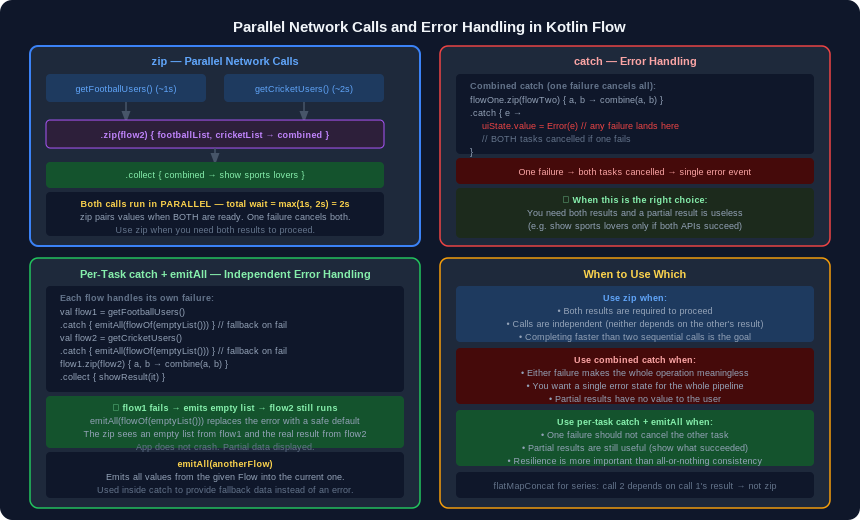
Two patterns appear in almost every real Android codebase: running two API calls at the same time and handling failures gracefully. The previous post covered sequential calls with flatMapConcat. This post covers parallel calls with zip and two strategies for handling errors — combined and per-task.
zip: Running Two Calls in Parallel
zip takes two Flows and pairs their emissions. Both Flows start collecting at the same time — in parallel.
val footballFlow: Flow<List<User>> = apiHelper.getFootballUsers()
val cricketFlow: Flow<List<User>> = apiHelper.getCricketUsers()

footballFlow
    .zip(cricketFlow) { footballList, cricketList ->
        findSportsLovers(footballList, cricketList)
    }
    .flowOn(Dispatchers.IO)
    .collect { sportsLovers ->
        showInUI(sportsLovers)
    }
Even though cricketFlow is written after footballFlow in the code, both calls launch simultaneously. zip waits until both have emitted and then combines the results in the lambda.
If the football call takes 1 second and the cricket call takes 2 seconds, the combined result arrives after 2 seconds — not 3. That is the value of parallelism: total time = the slower of the two, not the sum.
When zip Is the Right Choice
zip has a firm requirement: both results must be available before the lambda runs. This makes it the right tool when:
- Neither call depends on the other’s result.
- You need both to proceed (a partial result is not useful to the user).
- You want the combined result as soon as both finish.
If the second call depends on the first call’s result — for example, you need the uploaded image URL before calling updateProfile — then zip is wrong. Use flatMapConcat for that case, since the calls must run in series.
Error Handling: The catch Operator
catch is a Flow operator that intercepts any exception thrown upstream in the pipeline.
apiHelper.getUsers()
    .map { convertToUsers(it) }
    .catch { e ->
        uiState.value = UiState.Error(e.toString())
    }
    .collect { users ->
        uiState.value = UiState.Success(users)
    }
If anything upstream throws — the network call, the map transformation, anything — it lands in catch. The collector is never called with partial or broken data.
catch only intercepts exceptions that originate upstream of it. Exceptions thrown inside .collect { } itself are not caught here.
Combined catch with zip: One Failure Cancels Both
When a combined catch sits at the end of a zip chain:
footballFlow
    .zip(cricketFlow) { a, b -> combine(a, b) }
    .catch { e ->
        uiState.value = UiState.Error(e.toString())
    }
    .collect { result -> showInUI(result) }
If either footballFlow or cricketFlow throws an error, both tasks are cancelled and the error reaches catch. This is the correct behaviour when a partial result has no value — you need both API calls to succeed before showing anything.
Per-Task catch: Independent Error Handling
Sometimes one failure should not stop the other. Suppose one API going down should still let the other call succeed and show partial data. The solution is to add a catch block to each Flow individually, before they are zipped:
val footballFlow = apiHelper.getFootballUsers()
    .catch { emitAll(flowOf(emptyList())) }   // fallback: empty list on failure

val cricketFlow = apiHelper.getCricketUsers()
    .catch { emitAll(flowOf(emptyList())) }   // fallback: empty list on failure

footballFlow
    .zip(cricketFlow) { footballList, cricketList ->
        findSportsLovers(footballList, cricketList)
    }
    .collect { result -> showInUI(result) }
Now if footballFlow fails, it emits an empty list instead of propagating the error. cricketFlow is unaffected and continues normally. The zip lambda receives an empty list from the failed call and the real data from the successful one. The app does not crash, and the user sees whatever partial data is available.
emitAll: The Fallback Mechanism
Inside a catch block, you cannot call emit() directly — catch does not provide an emitter. Instead, use emitAll:
.catch { exception ->
    emitAll(flowOf(emptyList()))    // emit a fallback value downstream
    // or: emitAll(localCacheFlow)  // fall back to local cache
}
emitAll takes any Flow and emits all of its values into the current stream. The downstream collector sees the fallback values as if they had been emitted normally — it has no knowledge that an error occurred upstream.
Common fallback patterns:
// Emit an empty list
.catch { emitAll(flowOf(emptyList())) }

// Fall back to cached data
.catch { emitAll(localDatabase.getUsers()) }

// Emit a default object
.catch { emitAll(flowOf(User.default())) }
Practice Problem from the Class
The class notes include a worked example worth tracing through:
Make two network calls in parallel. After both succeed, save the combined data to a database. Then display the result.
val call1 = apiHelper.getNetworkData1().flowOn(Dispatchers.IO)
val call2 = apiHelper.getNetworkData2().flowOn(Dispatchers.IO)

call1
    .zip(call2) { data1, data2 ->
        data1 + data2          // combine — plain value, use zip transform
    }
    .flatMapConcat { combined ->
        database.save(combined)    // DB call returns Flow — use flatMapConcat
    }
    .catch { e ->
        uiState.value = UiState.Error(e.toString())
    }
    .collect {
        uiState.value = UiState.Success
    }
Step by step:
zipruns both network calls in parallel. Its lambda combines the results into a plain value — no Flow returned, sozip’s own transform is sufficient.flatMapConcattakes that combined value and passes it todatabase.save(), which is a Flow-returning operation — soflatMapConcatis required (notmap).- A single
catchat the end handles any failure across the whole pipeline.
Summary
| Operator / Pattern | Purpose |
|---|---|
zip | Run two Flows in parallel; wait for both; combine results |
Combined catch | One failure cancels all; single error state for the pipeline |
Per-task catch + emitAll | Each failure handled independently; partial results still flow |
emitAll | Emit a fallback Flow’s values inside a catch block |
The next and final post covers the full debounced search pipeline — debounce, filter, distinctUntilChanged, flatMapLatest — and compares flatMapLatest vs flatMapConcat vs flatMapMerge so you always choose the right one.