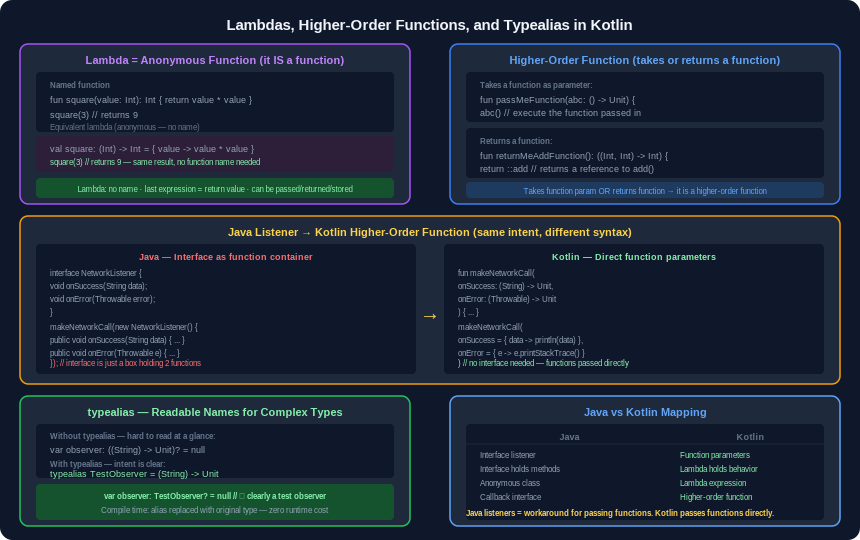
Lambdas and higher-order functions appear everywhere in Android development — click listeners, coroutine builders, Flow operators, and observer patterns all rely on them. Before understanding LiveData or any reactive pattern, it helps to have a firm mental model of what a lambda actually is.
Lambda: A Function Without a Name
The single most useful way to think about a lambda:
A lambda is a function.
Not a special construct, not a callback interface — a function. The only difference from a regular function is that it has no name.
A regular named function:
fun square(value: Int): Int {
    return value * value
}
square(3)   // returns 9
The equivalent lambda:
val square: (Int) -> Int = { value -> value * value }
square(3)   // returns 9
Both compute value * value. Both accept an Int and return an Int. The lambda has no name — square here is just a variable that holds the function, not the function’s own name.
Two things to notice:
- There is no explicit
returnstatement. The last expression in a lambda body is automatically the return value. - The type
(Int) -> Intdescribes the shape of the function: takes oneInt, returns oneInt.
Because a lambda is a value, it can be:
- Passed as an argument to another function
- Returned from a function
- Stored in a variable
- Used wherever a function of that shape is expected
Higher-Order Function
A higher-order function is any function that either:
- Takes a function as a parameter, or
- Returns a function, or
- Both.
// Takes a function as a parameter
fun passMeFunction(abc: () -> Unit) {
    // do something
    abc()   // execute the function that was passed in
}

// Returns a function
fun returnMeAddFunction(): ((Int, Int) -> Int) {
    return ::add   // :: is a function reference — references the existing add() function
}
passMeFunction takes a parameter named abc whose type is () -> Unit — a function that takes no arguments and returns nothing. Inside, abc() calls whatever function was passed in.
In Android development, the most common case is the first: functions that accept other functions as parameters. Returning functions is less frequent in day-to-day code.
Why This Matters: Java Listeners vs Kotlin Higher-Order Functions
In Java, passing behavior around required creating an interface. Consider a network call with two outcomes:
interface NetworkListener {
    void onSuccess(String data);
    void onError(Throwable error);
}

void makeNetworkCall(NetworkListener listener) {
    if (success) {
        listener.onSuccess(data);
    } else {
        listener.onError(error);
    }
}

// Usage
makeNetworkCall(new NetworkListener() {
    @Override
    public void onSuccess(String data) { /* handle success */ }

    @Override
    public void onError(Throwable error) { /* handle error */ }
});
The interface is just a container. It holds two functions — onSuccess and onError. When passing an implementation, two pieces of behavior are being passed together, wrapped inside an object.
Kotlin removes the wrapper. Functions can be passed directly:
fun makeNetworkCall(
    onSuccess: (String) -> Unit,
    onError: (Throwable) -> Unit
) {
    if (success) onSuccess(data) else onError(error)
}

// Usage
makeNetworkCall(
    onSuccess = { data -> println(data) },
    onError = { e -> e.printStackTrace() }
)
No interface declaration. No anonymous class. The functions are passed inline as lambdas.
makeNetworkCall is a higher-order function because it accepts functions as parameters.
The key insight: Java listeners were a workaround for passing functions. Kotlin supports passing functions directly, so the workaround is no longer needed.
Typealias: Readable Names for Complex Types
Function types like (String) -> Unit or (Article) -> Unit appear repeatedly across a codebase. On their own they are not immediately expressive — you have to parse the type to understand its intent.
typealias lets you give a meaningful name to any type:
typealias TestObserver = (String) -> UnitNow instead of:
var observer: ((String) -> Unit)? = nullyou write:
var observer: TestObserver? = nullThe second version communicates intent clearly: this is an observer used in testing.
Another common use in Android:
typealias ItemClickListener = (Article) -> Unit

class NewsAdapter(private val onItemClick: ItemClickListener) : RecyclerView.Adapter<...>()
Compared to declaring a parameter as (Article) -> Unit everywhere, ItemClickListener makes the adapter’s constructor self-documenting.
Important: typealias exists only in the source code. At compile time, every alias is replaced with its original type. The APK contains the original type — there is no runtime representation of the alias and no performance overhead.
The :: Operator — Function References
In the higher-order function example, ::add appeared. The double colon (::) creates a reference to an existing named function, turning it into a value that can be passed around:
fun add(a: Int, b: Int): Int = a + b

val addFn: (Int, Int) -> Int = ::add   // reference to add
addFn(3, 4)   // returns 7
This is equivalent to writing { a, b -> add(a, b) } as a lambda. The reference form is shorter when the function already exists.
:: also works on class members: viewModel::onButtonClick, adapter::submitList.
Java vs Kotlin Comparison
| Java | Kotlin |
|---|---|
| Interface listener | Function parameter |
| Interface holds methods | Lambda holds behavior |
| Anonymous class | Lambda expression |
| Callback interface | Higher-order function |
The mental shift: stop thinking about interfaces as the unit of behavior transfer. In Kotlin, functions are first-class values — they can be passed, returned, stored, and invoked like any other value.
Summary
- A lambda is an anonymous function. It has no name of its own, but it is a function in every other sense.
- A higher-order function takes a function as a parameter or returns one. Any function accepting a lambda qualifies.
- Java interface listeners are a workaround for passing functions that Kotlin makes unnecessary. The mental model transfers directly — an interface with one method is equivalent to a single function parameter.
typealiasassigns a readable name to any type, including complex function types. It is a compile-time alias with zero runtime cost.